Barrington, Robert
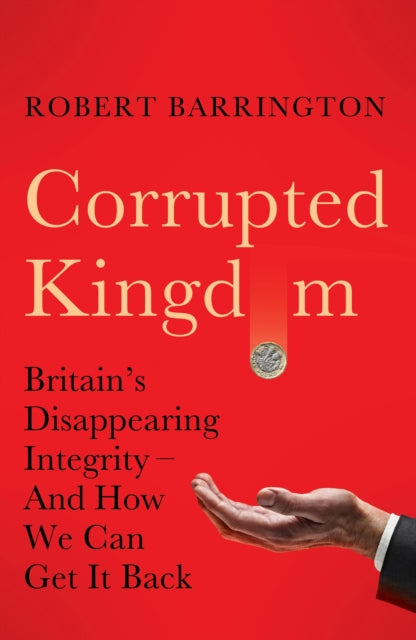
Corrupted Kingdom : Britain's Disappearing Integrity – And How We Can Get It Back
Corrupted Kingdom : Britain's Disappearing Integrity – And How We Can Get It Back
Couldn't load pickup availability
Author: Barrington, Robert
United Kingdom, Great Britain
Published on 16 July 2026 by Profile Books Ltd in the United Kingdom.
Hardback | 448 pages
162 x 242 x 40 | 672g
'Wonderful, highly readable and impassioned' Daron Acemoglu, author of WHY NATIONS FAIL'Required reading for anyone who cares about how democracy works - both as a warning and a call to action' Bill BrowderCash from anonymous donors. Cronyism in government contracts. Politicians who sell their influence to the highest bidder. Corruption is rife in British politics.
Britain is complacent about corruption. We are used to thinking of ourselves as firm defenders of fairness and the rule of law. But our institutions have never been more corrupt, from scandals in parliament and local government to crises in housing and the NHS. The evidence is impossible to ignore. Political leaders face a clear choice: tackle corruption or continue on the road to decline.
Robert Barrington is one of the world's leading researchers on corruption. Corrupted Kingdom is his comprehensive examination of how corruption manifests in Britain, from politicians to prisons, the Monarchy and the Met. He assesses the origins of corruption, from Londongrad to the end of Empire, and shows how we can best reverse the decline and restore trust in politics and the democratic process.
Vital and authoritative, Corrupted Kingdom provides an essential insight into why the abuse of power harms us all - and how we can banish corruption for good.
Review below by a member of our book buying team---
Robert Barrington’s vast experience of investigating corruption started with his first job, which was in the City, when his boss told him to look into the risks corruption poses to business and to follow the developing area of anti-corruption treaties. He then moved to Transparency International, later becoming its UK head, and he is now at the University of Sussex, as Professor of Anti-Corruption Practice at the Centre for the Study of Corruption.
Barrington starts with a clear way to identify corruption – look for entrusted power, abuse of that power, private gain thence, and harm to the public good. British corruption goes back centuries too; Edward Colebrooke, the head of the East India Company, who was prosecuted for it in 1829, was given an elephant among many other, and very lavish, bribes. Corruption is still extremely widespread today. Always focusing on facts and procedures, Barrington gives details of the phenomenon in almost every area of life – politics, the media, the private sector (not least construction), some of the uniformed services, local government (including planning permission), social elites, sport, even academic institutions, and he also raises some awkward issues around the monarchy.
So what can we do about all this? Anti-corruption action of any kind has become much more difficult since the Cameron government of 2010-15 abolished the Audit Commission, with the result that the chances of detection have fallen sharply. Now things are very confused; there are no fewer than 48 different auditing bodies across a range of fields, all, it seems, with their own powers and their own definitions of corruption. Many of the bodies they audit seem not to have accurate or complete accounts either. As for public inquiries, they are often given very limited powers and their access to documents is invariably restricted. All, however, is not lost, and Barrington outlines several good ideas for better enforcement. Tighter law also seems to be in preparation; we need it.
If you cannot find the book you're after, please click here.
View full details